
What if a virus that infects almost everyone could help trigger a serious neurological disease years after the initial infection? This is a question scientists have been investigating for decades, and recent work points to one candidate in particular: Epstein-Barr virus (EBV).
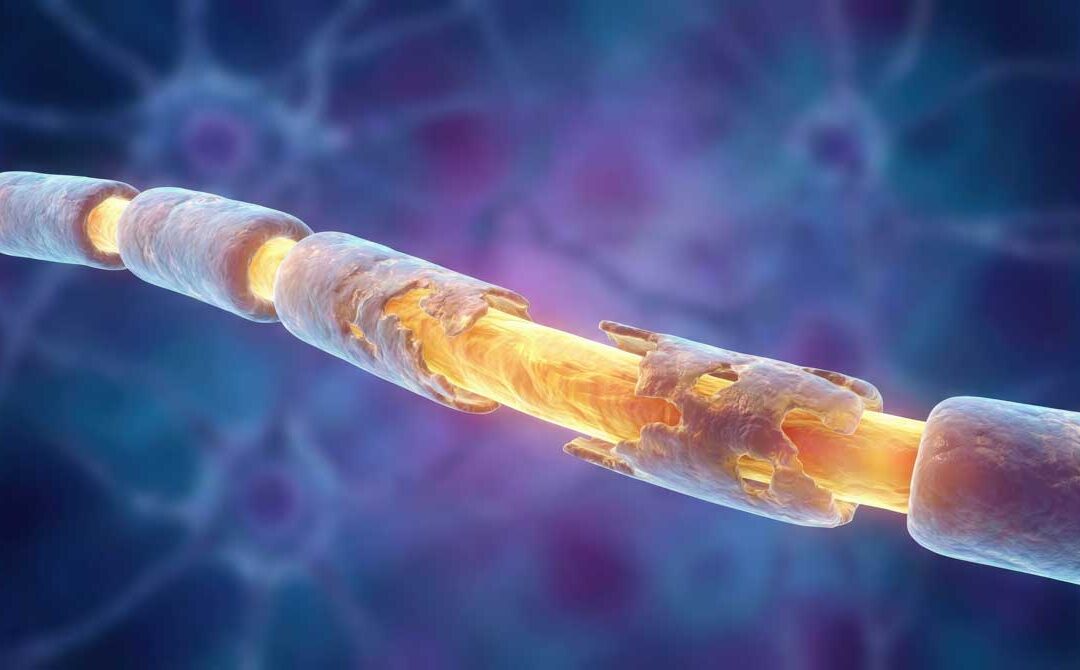
Multiple sclerosis (MS) is a chronic condition in which the immune system attacks myelin, the protective coating around nerve fibres in the brain and spinal cord. For decades, researchers have suspected that an infection might set the process in motion. In recent years, that evidence has become considerably stronger [1,3].
EBV is a herpesvirus and one of the most widespread human viruses, infecting more than 90% of adults worldwide. Most people catch it in childhood, often with no noticeable symptoms, but if infection first happens in adolescence or young adulthood, it can cause infectious mononucleosis (“glandular fever” or “mono”). After the initial infection, EBV stays in the body for life, persisting mainly in a type of immune cell called B cells. Yet most people who carry EBV never develop MS. The evidence suggests that EBV may be a necessary factor in most cases of MS, but that infection alone is not sufficient to cause the disease [3].
The Evidence Linking EBV to MS
Studies going back decades found that nearly everyone with MS has evidence of past EBV infection, and that people who had infectious mononucleosis have roughly double the risk of later developing MS. These findings were suggestive, but correlation alone could not show that EBV came first [3].
The turning point came in 2022, when a Harvard-led team published a study in Science using blood samples stored from more than 10 million young adults serving in the US military. Researchers identified 801 people who went on to develop MS and compared them with matched controls. Among people who were EBV-negative at the start, the risk of MS increased about 32-fold after they became infected with EBV. No comparable increase was seen after infection with cytomegalovirus, another common herpesvirus [1].
Researchers also measured a protein called neurofilament light chain (NfL) in blood samples. NfL is released when nerve cells are damaged, so higher levels can be an early warning sign of neurological injury. In people who later developed MS, NfL levels were normal before they caught EBV and only started to rise afterwards. This timing matters: it suggests the virus came first and the nerve damage followed, rather than early, undetected MS making people more likely to catch EBV [1].
In that study, only one MS case occurred in a person who had not been infected with EBV beforehand. This is why many researchers now consider EBV infection a near-prerequisite for MS [1,3].
How Might a Virus Cause MS?
Scientists are still working out the mechanism, and several ideas are being tested. They are not mutually exclusive.
Molecular mimicry. One of the most compelling explanations involves a phenomenon known as molecular mimicry. When EBV infects the body, the immune system produces antibodies against specific viral proteins. One of these proteins is Epstein-Barr nuclear antigen 1 (EBNA1), which is involved in maintaining the viral genome during latency.
In 2022, researchers published a study in Nature demonstrating that certain antibodies directed against EBNA1 could also recognise GlialCAM, a protein found in the central nervous system [2].
This phenomenon is known as cross-reactivity. Certain viral and human protein structures can appear sufficiently similar that the immune system recognises both. As a result, an immune response initially directed against EBV may also react with the body’s own tissues. This could contribute to autoimmune inflammation and neurological damage. Molecular mimicry is therefore a promising explanation, although it does not fully explain how MS develops [2,3].
Infected B cells. Another important clue comes from the cells that EBV infects. EBV establishes lifelong latency primarily within B lymphocytes, which also play a central role in the immune processes involved in MS. B cells can produce antibodies, present antigens to other immune cells and release inflammatory signalling molecules.
Therapies that deplete certain populations of B cells are among the most effective treatments for relapsing forms of MS. This highlights the importance of B cells in the disease, although it does not independently demonstrate that EBV-infected B cells are responsible. Researchers are investigating whether persistent EBV infection alters B-cell behaviour, promotes abnormal immune responses or contributes to chronic inflammation [3].
Immune dysregulation. Unlike many acute viral infections, EBV is not completely eliminated from the body. Instead, the virus persists within a small population of infected cells, normally under tight immune control. Scientists are investigating whether this lifelong interaction between EBV and the immune system could contribute to abnormal immune activation in susceptible individuals. Molecular mimicry, altered B-cell function and immune dysregulation may act together in the development of MS [3].
If EBV Is So Common, Why Doesn’t Everyone Develop MS?
This is one of the most important questions. More than 90% of adults worldwide have been infected with EBV, yet only a small proportion develop multiple sclerosis. The Atlas of MS estimated that approximately 2.8 million people worldwide were living with MS in 2020 [4].
This strongly suggests that EBV infection alone is insufficient to cause the disease. Instead, MS appears to result from a complex interaction between viral exposure, genetic susceptibility and environmental factors [3].
Certain genetic variants are associated with an increased risk of MS. Environmental and lifestyle factors also appear to influence susceptibility. These include smoking, low vitamin D status and obesity during adolescence or early adulthood.
The timing of EBV infection may also matter. Individuals who develop symptomatic infectious mononucleosis during adolescence or adulthood have a higher subsequent risk of MS than those without such a history. MS is also more common in women than men, suggesting that biological sex may influence disease susceptibility [3].
The emerging picture is that EBV may be an important initiating or contributing factor, while other influences determine whether the disease ultimately develops.
Putting the EBV and MS Link in Perspective
Although the association between EBV and MS is strong, the overwhelming majority of people infected with EBV will never develop multiple sclerosis. Having had glandular fever or testing positive for EBV antibodies does not mean that someone will develop MS [3].
It is also important to understand that MS itself is not contagious. Although EBV can spread between people, multiple sclerosis cannot be transmitted through ordinary contact.
The significance of this research lies primarily in understanding disease mechanisms and identifying potential opportunities for prevention.
Could MS Be Prevented in the Future?
The EBV connection opens up new possibilities for prevention and treatment. Several candidate EBV vaccines are in development and clinical investigation, and if one proves effective at preventing infection, it could theoretically reduce MS cases [3].
However, demonstrating that an EBV vaccine prevents MS would be challenging. Multiple sclerosis can develop many years after infection, meaning prevention studies would require large populations and long-term follow-up.
Researchers are also investigating whether targeting EBV or EBV-infected cells could provide new treatment strategies for people already living with MS. These approaches remain investigational, and there is currently no established EBV-targeted antiviral treatment proven to prevent or cure MS.
The discovery has nonetheless opened an important new direction for research.
A New Perspective on the Long-Term Consequences of Viral Infections
The connection between EBV and multiple sclerosis represents a significant advance in our understanding of how infections may contribute to chronic disease. It also challenges the traditional view that the consequences of a viral infection are limited to the symptoms experienced during the acute illness.
Some viruses can establish lifelong infections, interact with the immune system and potentially influence disease processes long after the initial exposure.
In the case of EBV and MS, researchers now have compelling epidemiological evidence, supported by emerging biological mechanisms, suggesting that a common viral infection may play an important role in the development of a serious neurological disease [1,2,3].
Many questions remain unanswered, particularly why only certain individuals develop MS and whether preventing EBV infection will reduce future disease risk.
How VRS Can Help
Understanding how a persistent virus shapes long-term disease depends on assays that can measure infection, latency and the effect of candidate compounds reliably. We support antiviral and vaccine programmes across a broad range of viruses, from antiviral drug screening through to neutralisation assays for evaluating antibody responses. Get in touch to discuss how we can support your research.
References
- Bjornevik K, et al. Longitudinal analysis reveals high prevalence of Epstein-Barr virus associated with multiple sclerosis. Science. 2022;375(6578):296-301. doi: 10.1126/science.abj8222
- Lanz TV, et al. Clonally expanded B cells in multiple sclerosis bind EBV EBNA1 and GlialCAM. Nature. 2022;603:321-327. doi: 10.1038/s41586-022-04432-7
- Robinson WH, Steinman L. Epstein-Barr virus and multiple sclerosis. Science. 2022;375(6578):264-265. doi: 10.1126/science.abm7930
- Walton C, et al. Rising prevalence of multiple sclerosis worldwide: insights from the Atlas of MS, third edition. Multiple Sclerosis Journal. 2020;26(14):1816-1821. doi: 10.1177/1352458520970841